Magnetic Metals and Non-Magnetic: What Sticks, What Doesn’t, and Why
Here's a fun fact: China accounts for nearly 70% of global rare earth mine production and dominates much of the processing and magnet supply chain. This matters because rare earth elements like neodymium and dysprosium are what make modern magnets work. When supply chains are that concentrated, it makes people a little uneasy.
And that unease trickles down to a much simpler question that comes up every day in shops and engineering offices: what metals are magnetic, which ones aren't, and does it really matter when you're ordering a steel plate?
Turns out, it matters quite a bit. Not because magnetism is all that complicated. But knowing which metals are magnetic and which aren't affects how you handle material, what you pay for it, and how it performs once it's installed or on the equipment.
Why Some Metals React to Magnets and Others Do Not
Magnetism comes down to what's happening at the atomic level. It's about electron spin and how atoms arrange themselves. In some metals, the structure lets magnetic domains form and line up. In others, it doesn't. That's really what separates the metals that attract from the ones that don't.
What Makes a Metal Magnetic?
The technical term is ferromagnetism. It describes materials that respond strongly to magnets and can sometimes become magnets themselves. In ferromagnetic materials, many magnetic domains can align in the same direction, creating a strong magnetic response and a magnetic field.
One thing worth noting: magnetic strength and mechanical strength are two completely different things. Steel is strong and magnetic. Titanium is just as strong in many applications, and it's not magnetic at all.
Ferromagnetic, Paramagnetic, and Diamagnetic Metals
Every metal fits into one of these three buckets.
Ferromagnetic metals are the ones you actually notice. They grab onto magnets. Iron, nickel, cobalt, and most steels are in this group.
Paramagnetic metals like aluminum have a weak attraction that you can't really see. The effect exists, but it's so small it doesn't matter for practical purposes.
Diamagnetic metals like copper and silver actually push away from magnetic fields. Not with any force you'd notice. But that's what's happening.
Which Metals Are Magnetic?
The list isn't long. If you want metals that are magnetic, you're mostly looking at ferrous materials.
Iron, Nickel, and Cobalt
Alloys based primarily on iron, nickel, or cobalt often show magnetic properties, but behavior still depends on composition and crystal structure.
Iron in its pure form has very little carbon. It's soft, ductile, and gets stronger when you work it. Nickel and cobalt are more commonly found in specialty alloys where you need specific magnetic or corrosion properties.
Steel and Steel Plate
Carbon steel and mild steel are mostly iron, so they are magnetic whether hot-rolled or cold-rolled.
However, galvanized steel has a zinc coating to stop rust. The coating is thin enough that it doesn't interfere with the magnetic properties. So you get corrosion resistance and magnetic behavior all in one package.
Magnetic Stainless Steel Grades
Here's where people get tripped up. Not all stainless is the same.
The 400 series, ferritic and martensitic stainless, is magnetic. High iron content, right atomic structure. Type 430 and Type 440 are good examples.
300-series austenitic stainless steels, such as 304 and 316, are generally non-magnetic in the annealed condition.
Which Metals Are Non-Magnetic?
Most metals, actually. If you're asking what metals are not magnetic, the list is longer than the magnetic one.
Aluminum, Copper, Brass, Lead, Gold, and Silver
These metals are generally non-magnetic in common commercial forms because they are not ferromagnetic. Notably, copper interacts with moving magnetic fields through eddy currents. But that's not the same as being magnetic.
Non-Magnetic Stainless Steel Grades
Austenitic stainless steels, like 304 and 316, are non-magnetic. Most of the time.
But here's the catch: cold working can change that. When you cut, bend, or machine these grades, you can create enough stress to transform some austenite into martensite. Martensite is magnetic.
So a 304 plate might be non-magnetic when it arrives. After you shear it, the edge might show some magnetic pull. 316 is more stable because it has more nickel. It resists this transformation better.
Solution annealing can restore the austenitic structure and reduce magnetic response.
Magnetic vs Non-Magnetic Metals at a Glance
| Metal | Magnetic Behavior | Common Form/Alloy | Note |
|---|---|---|---|
| Iron | Magnetic | Cast iron, wrought iron | Base metal for most magnetic alloys |
| Carbon Steel | Magnetic | Hot rolled, cold rolled | Strong and durable, prone to rust |
| Galvanized Steel | Magnetic | Coated steel | Zinc coating doesn't block magnetism |
| Ferritic Stainless (430) | Magnetic | 400 series | Good corrosion resistance, magnetic |
| Martensitic Stainless (440) | Magnetic | 400 series | Hard, magnetic, used in cutlery |
| 304 stainless steel | Non-magnetic | Austenitic | Can become weakly magnetic when cold worked |
| 316 stainless steel | Non-magnetic | Austenitic | More stable, less likely to become magnetic |
| Aluminum | Non-magnetic | Various alloys | Weakly paramagnetic, not visible |
| Copper | Non-magnetic | Pure copper, brass | Diamagnetic, interacts with moving fields |
| Lead | Non-magnetic | Pure lead | No magnetic response |
| Titanium | Non-magnetic | Various alloys | Strong but non-ferromagnetic |
Common Myths About Magnetic and Non-Magnetic Metals
These myths never die. Here's the reality.
- All metals are magnetic. No. Only ferromagnetic ones.
- Shiny metals are magnetic. Appearance has nothing to do with it.
- Non-magnetic metals can't be detected by metal detectors. They can. Metal detectors look for conductivity, not magnetism.
- Magnetic strength means metal strength. No connection there at all.
- Magnetic metals are always permanent magnets. No. Many ferromagnetic metals are attracted to magnets without being permanently magnetized themselves.
Why Magnetic Properties Matter in Metal Selection
Recycling: Magnets do the heavy lifting at scrap yards, pulling ferrous metals out of the mix so they can be processed separately.
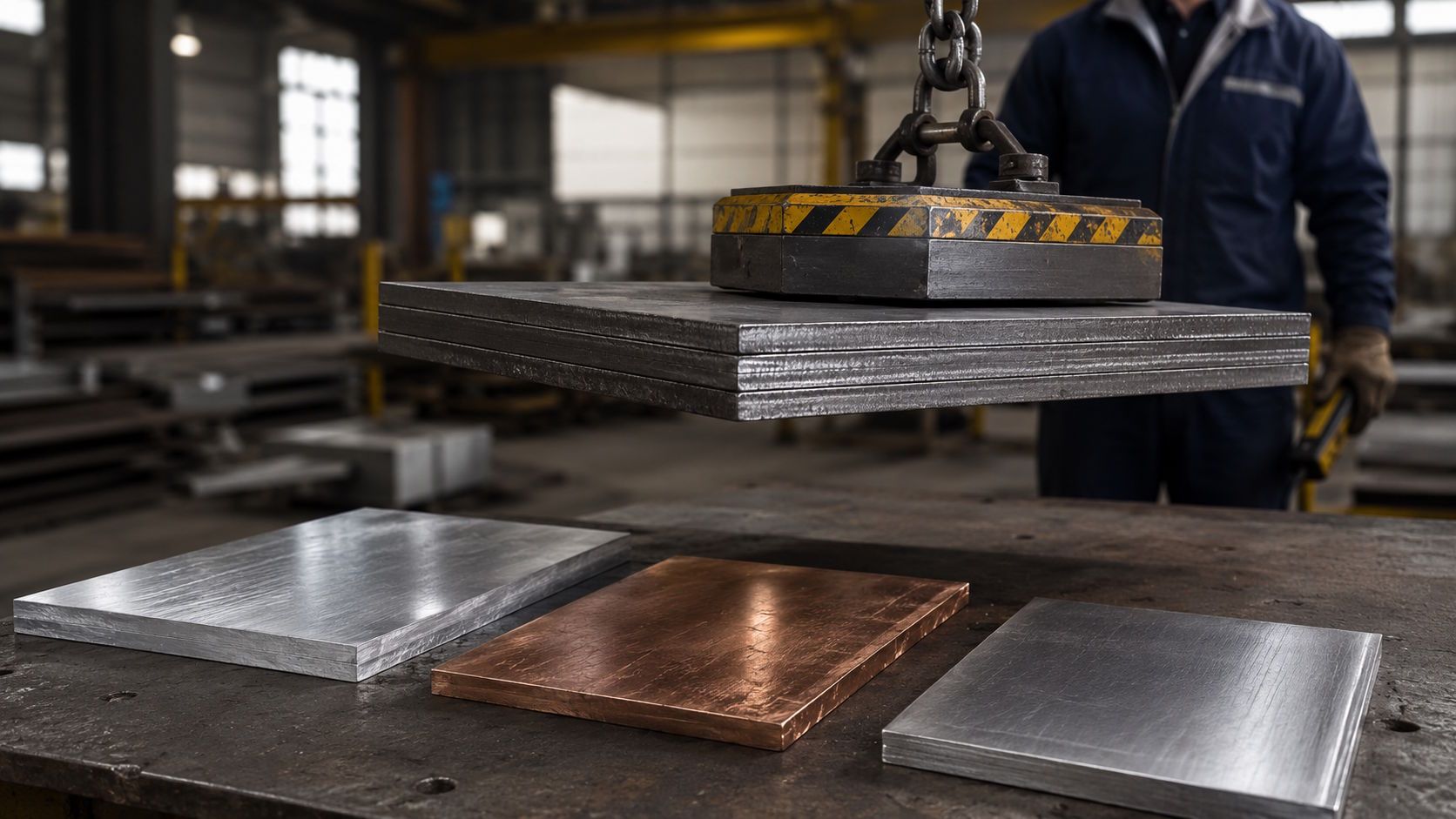
Fabrication: Magnetic chucks and lifts hold parts in place and move material around in metalworking shops.
Equipment design: Some applications, such as MRI rooms, require non-magnetic materials to avoid interference.
Stainless identification: A simple magnet test can give you a rough idea whether you're dealing with ferritic or austenitic stainless steel.
Electrical applications: Motors and generators need magnetic materials to function.
Magnetic Metals in Steel Plate Applications
For anyone buying a steel plate, this matters. While carbon steel plate is always agnetic, stainless plate depends on the grade:
Ferritic grades like 430 are magnetic. They're used in automotive trim and appliamnces.
- Martensitic grades like 440 are magnetic and hardenable. Cutlery and bearings.
- Austenitic grades like 304 and 316 are non-magnetic when annealed. But cold work can introduce magnetic spots.
If you need non-magnetic stainless for something sensitive, specify a high-nickel grade or require solution annealing after fabrication. If you're using magnetic lifting, ferritic grades will work. Austenitic grades generally should not be relied on for magnetic lifting.
Conclusion: Choosing Metals by Magnetic Behavior
Figuring out which metals are magnetic is easy. Iron, nickel, cobalt, and most steels are magnetic. Aluminum, copper, brass, lead, gold, silver, and austenitic stainless steel are non-magnetic. Don't assume. Check the grade. Understand the composition. Also, consider whether cold work could change things.
FAQ
About the author

Chad Odom, based in Mobile, AL, US, is currently a General Manager at Premium Plate, a TF Warren Company. Chad Odom brings experience from previous roles at Total Plate Processing, a TF Warren Company and O'Neal Steel. Chad Odom holds a 2001 - 2002 University of South Alabama. With a robust skill set that includes Aluminum, Contract Negotiation, Continuous Improvement, Inventory Management, Manufacturing and more.
View all postsRecent Posts

Premium Plate Plans $20M Mobile County Facility
What Is Marine Steel Plate and How Is It Used in Vessel & Barge Repair?
Mining Equipment Maintenance: How Steel Plate Reduces Downtime
Steel Plate vs Sheet: Key Differences, Thickness, and Applications Explained