What Is Metal Fatigue? Warning Signs and Prevention
Metal fatigue is responsible for an estimated 90% of all metallic failures. Given that these failures happen at stress levels far below what the material could handle in a single load, a sudden break often leaves everyone wondering what went wrong.
With that in mind, it’s prudent to understand what is metal fatigue, how it develops, and the warning signs to watch for. This is essential for improving safety, reliability, and service life.
Why Repeated Loads Can Weaken Metal
Anyone who has ever straightened a paper clip and bent it back and forth until it snapped has witnessed metal fatigue firsthand. The clip did not fail because the force applied was greater than what the steel could handle in a single pull. It failed because the repeated bending, cycle after cycle, created microscopic damage that gradually accumulated until the material could no longer hold together.
In engineering and industrial settings, the same fundamental process occurs across countless applications and components. Structures and machinery endure stresses day in and day out from loading, unloading, vibration, rotation, and thermal expansion. These cyclic loads can initiate localized damage at surfaces, welds, defects, or other stress concentrations. The damage accumulates over time, and the danger is that it often remains hidden until it is too late.
What Is Metal Fatigue?
Metal fatigue is the progressive weakening of a material caused by repeated loading and unloading. It is not the kind of failure you get from overloading a hoist or dropping a heavy weight on something. That is a single-event overload failure rather than a fatigue failure.
Fatigue does not work that way. It develops slowly, often over months or years. The stress cycles can be well below the material's ultimate tensile strength, but they take a toll. Each cycle causes localized damage, usually at a surface irregularity or microscopic flaw. Over thousands or millions of cycles, that damage becomes a crack. Once the crack forms, it keeps growing until the remaining metal cannot carry the load.
How Fatigue Failure Develops
The progression from an intact component to fatigue failure generally follows three stages:
Crack Initiation
Fatigue typically begins with a microscopic crack. Cracks commonly initiate at sharp corners, scratches, weld toes, inclusions, or other stress concentrations.
What makes this stage dangerous is the stress level. You do not need to be anywhere near the material's ultimate tensile strength to start a micro-crack. In many cases, the cyclic stress that causes initiation is below the yield strength.
Crack Propagation
Once the micro-crack forms, the second stage begins. Each subsequent load cycle forces that crack to grow a little more. The crack changes direction as it grows, usually orienting itself perpendicular to the tensile stresses on the part. It follows paths of least resistance through the material.
This stage is not linear. The crack grows slowly at first, but as it gets longer, the stress at the tip increases. The growth rate accelerates. This is where periodic inspection can catch something. The crack is still small but may be detectable with non-destructive testing methods.
Final Fracture
The third stage is sudden. The crack has grown large enough that the remaining cross-section can no longer carry the load. The material lets go. The fracture surface might be ductile or brittle. Either way, it happens fast. Final fracture can occur rapidly once the remaining cross-section can no longer support the applied load.
Main Causes of Metal Fatigue
Now that you understand what is fatigue in metals, what are its main causes? Repeated loading is the obvious answer, but several other factors determine how quickly damage develops and how long a component survives.
Load Cycles, Vibration, and Changing Stress
Fatigue life depends on the number of cycles, stress range, mean stress, geometry, material, and service environment. A part swinging between high and low stress fails faster than one with a narrow range, even if the average stress is identical.
Then there's vibration. A humming machine or airflow rattling a panel can create thousands of small load cycles every minute. The stress amplitudes multiply. Static calculations miss this. They see the primary load, not the chatter, not the oscillation, not the back-and-forth flex that wears metal down from the inside.
Stress Concentrations and Poor Geometry
Sharp corners, notches, and holes or changes in cross-section can concentrate stress. The stress piles up at these features, often reaching several times the average stress. That is where cracks start.
With that in mind, generous fillets and smooth transitions are not just nice to have. They are essential for fatigue resistance. A sharp corner can significantly reduce fatigue life by increasing local stress.
Surface Condition and Fabrication Quality
A smooth, well-finished surface delays crack initiation. A rough one accelerates it. Scratches, tool marks, grinding burns, and rough finishes all act as stress risers where cracks can start early. The smoother the surface, the longer the fatigue life.
Meanwhile, the heat-affected zone next to a weld can have different metallurgical properties from the base metal. Porosity, slag inclusions, undercut, and other weld discontinuities can also create stress concentrations where fatigue cracks may initiate. The Federal Highway Administration identifies welded details, connections, and attachments as common fatigue-prone areas in steel structures, particularly under repeated loading, highlighting the importance of high-quality plate processing services.
Corrosion and Service Conditions
Corrosion pits create stress concentrations. They're crack starters. The corrosion process itself can generate hydrogen, which embrittles certain metals and makes them more susceptible to cracking. Then, once a fatigue crack forms, the corrosive environment attacks the crack face directly. Propagation accelerates. Life shortens.
Parts in harsh environments need coatings, sealants, and the right material choice. What works in a clean, dry shop may fail prematurely outdoors or in wet conditions. Blast and prime services are often essential to ensure proper corrosion protection.
How Fatigue Resistance Is Measured
Fatigue testing generates S-N curves. Engineers take highly polished specimens and run them through reversed stress cycles at various levels until they break. The results get plotted with stress on one axis and cycles to failure on the other.
For some steels, the S-N curve may approach an endurance-limit region at high cycle counts. That is the endurance limit. Some steels exhibit an endurance-limit region under controlled test conditions, but real components still require adjustments for geometry, surface condition, environment, and variable loading. For non-ferrous metals like aluminum, there is no flat part of the curve. Aluminum alloys generally do not show a clearly defined endurance limit, so fatigue strength is specified for a selected number of cycles.
Where Fatigue Failure Commonly Occurs
Fatigue shows up everywhere metals are used under repeated stress. Bridges are a classic example. Traffic loads might be modest compared to capacity, but after millions of truck crossings, fatigue cracks develop in structural steel.
Aircraft are the most well-known example. Every flight cycle pressurizes the fuselage and loads the wings. The de Havilland Comet disasters in the 1950s were a harsh lesson in what happens when you do not account for fatigue.
Automotive suspension parts see constant cyclic stress from the road. Rotating machinery puts fatigue loads on shafts and gears. Heavy equipment has structural members under cyclic loads from lifting and traveling. Welded steel plate structures, from pressure vessels to ship hulls, are especially vulnerable.
Warning Signs and Fatigue Crack Detection
Fatigue damage may produce few obvious external warning signs before a crack reaches a critical size.
That said, visible cracking is a dead giveaway. Changes in vibration or noise from rotating equipment can indicate that a crack is growing. Unusual heat at a joint can also be a clue. But these cues are not reliable.
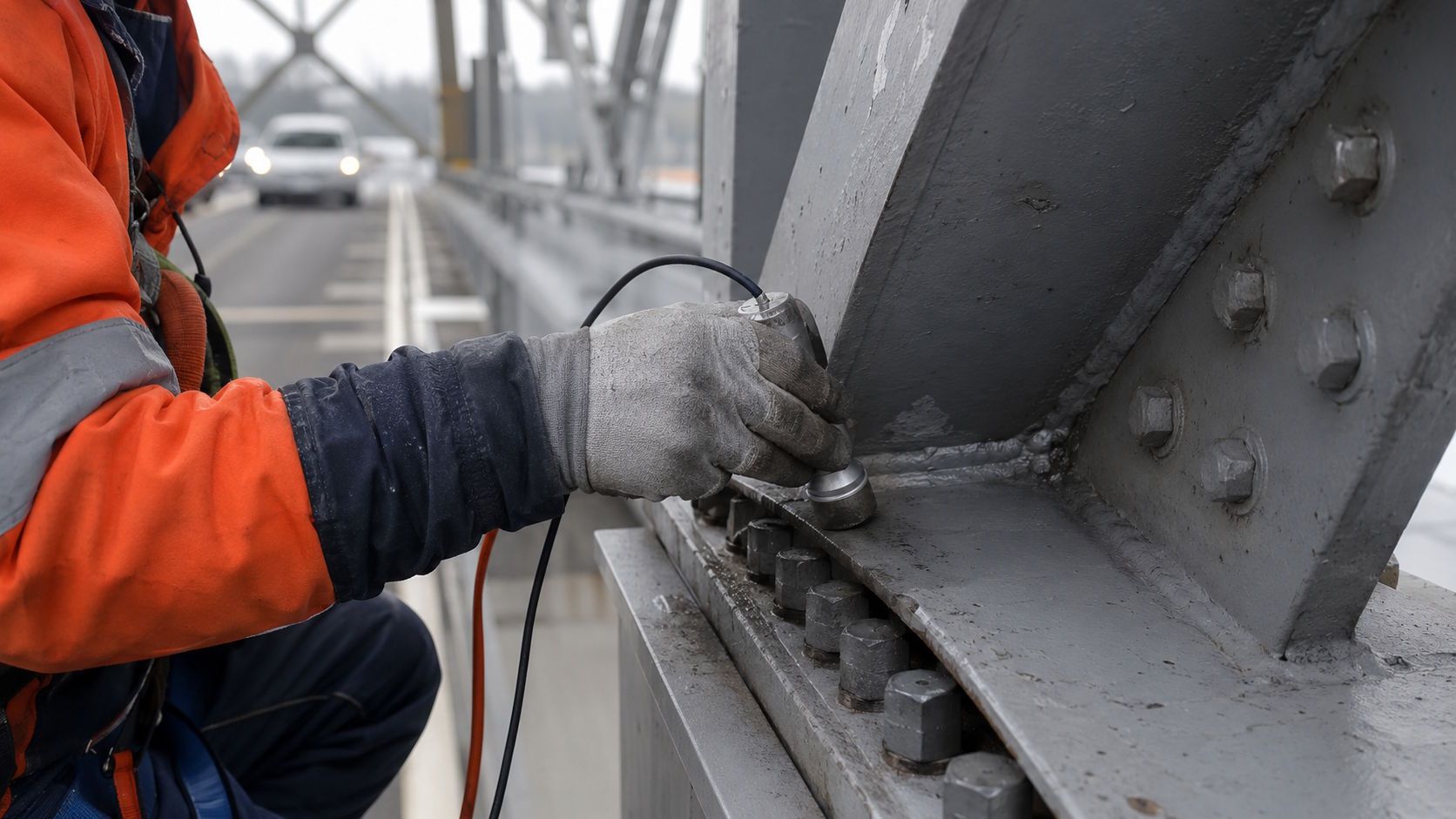
Non-destructive testing is often essential for fatigue-prone or safety-critical components:
- Ultrasonic testing – detects cracks with high-frequency sound waves
- Eddy current testing – finds surface and near-surface defects
- Liquid penetrant testing – reveals surface cracks with dye
How to Prevent Metal Fatigue
Prevention combines good design, fabrication, and maintenance.
Start with design. Eliminate stress risers. Use generous fillets, smooth transitions, and avoid sharp notches. Perform fatigue analysis during design, before fabrication begins.
Material selection also matters. For steel and aluminum alloys, evaluate fatigue strength at the relevant number of cycles and under the actual loading conditions. Pick the material with better fatigue performance for your loading conditions.
At the same time, fabrication quality is critical. Keep surfaces smooth. Control welding to minimize undercut and porosity. Use post-weld treatments like grinding or peening.
Shot peening is another effective tool. It creates compressive residual stress that fights crack initiation. Corrosion protection cannot be an afterthought. Coatings and proper material selection keep corrosion pits from creating early initiation sites.
Load management means controlling what you can. Balance rotating parts. Avoid shock loading. Use isolation mounts where needed.
Scheduled inspection is the safety net. Regular NDT can detect cracks during the propagation stage before they reach a critical size. Establish intervals based on fatigue life, not calendar time.
Conclusion: Reducing the Risk of Fatigue Failure
Metal fatigue can progress with little visible deformation and may remain undetected without appropriate inspection. In some cases, the first obvious sign is a component that fails unexpectedly.
And here's the truth: fatigue is a design and maintenance problem, not just a material problem. Smooth surfaces, generous fillets, proper welding, corrosion protection, and regular inspections all help extend fatigue life. But the real answer is understanding your loads, knowing your material's limits, and inspecting before something fails.
FAQ
About the author

Chad Odom, based in Mobile, AL, US, is currently a General Manager at Premium Plate, a TF Warren Company. Chad Odom brings experience from previous roles at Total Plate Processing, a TF Warren Company and O'Neal Steel. Chad Odom holds a 2001 - 2002 University of South Alabama. With a robust skill set that includes Aluminum, Contract Negotiation, Continuous Improvement, Inventory Management, Manufacturing and more.
View all postsRecent Posts

Premium Plate Plans $20M Mobile County Facility
What Is Marine Steel Plate and How Is It Used in Vessel & Barge Repair?
Mining Equipment Maintenance: How Steel Plate Reduces Downtime
Steel Plate vs Sheet: Key Differences, Thickness, and Applications Explained